Cardboard Castles and Other Amenities...

I am really interested in using different forms of cultural action to help build better communities. Communities are a vital social model, allowing us to tackle problems beyond the ability of individuals with the focus of a defined (usually relatively small) group of people. How do the arts and cultural work in general help communities grow more sustainable futures? If you have a cool website or project or your own ideas on these subjects please let me know.

Saturday, March 03, 2007

...Of Interest II


Couple of things worth checking out.

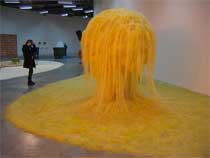
Michel Blazy's Post Patman is a really interesting look exhibit at the Palais de Tokyo in Paris. We-make-money-not-art has a really interesting post on it. The exhibit is a series of sculptures made of organic matter. Through the process of decomposition the sculptures are always changing.

Transitions - Biographies between GDR and Federal Republic of Germany is a really cool photo exhibit at the German Historical Museum. “Just after the fall of the Wall photographers Angelika Kampfer and Ewald Hentze set off to photograph the people in a state they knew would soon no longer exist. They returned to photograph the same people in 1992 then in 2004 and 2005. Nothing remains of the pathos of work that could still be felt in 1989. The spaces captured in 1989 to a large extent recall the early 20th century. The factories, craft centres and schools have all since been modernised. The brief span of sixteen years saw the emergence of the tidy world of employees and sanitary workplaces, the fully rationalised world one has to get along in - some much better than before, others not as well.” (Quoted from Transitions at We-make-money-not-art.)

Labels: , , ,

Tuesday, February 27, 2007

Picturing the Numbers, Picturing the Problems


You all should check out Chris Jordan’s “Running the Numbers”. It is a really interesting photographic representation of some pretty staggering statistics. For example, the picture shown “Depicts 1.14 million brown paper supermarket bags, the number used in the US every hour.” I really like this image because it references the one of the major problems with using so many paper bags, that we have to cut down so many trees. Some of his other images are just interesting looking piles.

Labels:

Wednesday, July 19, 2006

Peoples' stories = communities' stories.


The Autobiography Project is an interesting community expression project taking place in Philadelphia right now. Over six weeks this spring the Benjamin Franklin Tercentenary and One Book, One Philadelphia sought out 300 word autobiographies from the city’s residents. They received over 340 entries. From these admissions, 20 were selected by a panel of local writers to be published on posters and put up in bus stops.

There are several aspects of this project with exciting implications. First off, any effective community envisioning project must contain an understanding of the communities past. Not only are important lessons to be learned from one’s history, but also most communities have a desire to retain something of their “historic” selves. Now, 20 autobiographies hardly constitute a complete history, but they do point out that personal stories in combination with avenues for public expression (in this case public space) can be used to tell a communities story.

The second interesting aspect of the Autobiography Project as Geoff Manaugh of Worldchaning.com points out

...is how it has briefly reclaimed a handful of Philadelphia's bus shelters and transport routes in the name of public life and personal narrative. De-commercializing each bus stop, in other words, the Project has replaced ads for new films, hair products, and athletic gear, turning Philadelphia's bus routes into a narrative experience.

As our public spaces become more and more privatized and commercialized, cultural actions that work against this trend take on greater importance as means of securing spaces for public expression.

Labels: ,