Materialism in the 21st Century; Not What You Think

This is pretty interesting. Bruce Sterling discusses the end of The Viridian Design Movement. Check it out.
Image: http://greensource.construction.com/people
Labels: Design, Worldchanging
I am really interested in using different forms of cultural action to help build better communities. Communities are a vital social model, allowing us to tackle problems beyond the ability of individuals with the focus of a defined (usually relatively small) group of people. How do the arts and cultural work in general help communities grow more sustainable futures? If you have a cool website or project or your own ideas on these subjects please let me know.

Labels: Design, Worldchanging

Labels: Design, We-make-money-not-art, Youth
If sustainability is harvesting, designing, using, and end-of-life management in ways that will work for hundreds, if not thousands, of years than one important concept to understand is that future generations will only have access to the resources we have today. That is to say every generation does not get their own Amazon forest. The resources we use (or don’t use) today will be all the resources future generations have access to. What are the Sustainability Implications of Peak Population? By Alex Steffen (The broskie) deals with the implications of trying to build a sustainable now, while also realizing that it is going to have to work for or be recyclable by future generations. It’s a typically interesting thought exercise, and for those of you less familiar with The Broskie I recommend you take a look.
Labels: Design, Sustainability, Worldchanging
The Revolution Will Not Be Designed is interesting (and blissfully short) reminder that when dealing with human problems we must deal with human interactions (including political, social, and cultural.)
Labels: Design

I don't like the word manifesto. It reeks of dogma and rules—two things I instinctively reject. I do love the way it puts things on the line, but I don't like lines, or groups. So a manifesto probably isn't for me. The other thing about manifestos is that they appear (or are written so as to appear) self-evident. This kind of a priori writing is easy, since you simply lay out what seems obviously—even tautologically—true.
Of course, this is the danger of manifestos, but also what makes them fun to read. And fun to write. So I'll write this manifesto. I just might not sign it.
It makes me think about my own manifesto writing, which was definitely a lot of fun to write. However, it makes sense to say that manifestos draw lines, which are problematic, and that we should consider carefully which, if any, lines we want to draw.
Labels: Design, Sustainability, Worldchanging
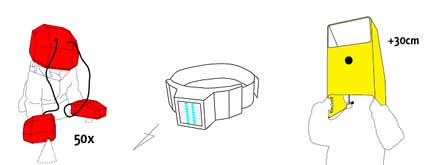
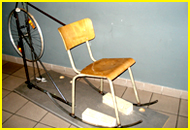
In a world where sustainable energy creation is one of the largest problems facing the world, The Human Power Objects Workshop looks like a really important re-focusing of our conception of what is and what is not a source of energy. The workshop was headed by Myriel Milicevic and there is an interesting (efficient, i.e. short) interview with her at We-make-money-not-art. Milicevic wrote in the introduction to the online report that "While technology so far has been developed towards a state of minimum human effort, this workshop now explores the potential of using the human body itself as a renewable power source." There seems to be convergence from many different angles that humans should be actively engaging with technology. From one angle, lots of people are talking about how games like Dance Dance Revolution can be used as a weight loss option, especially for kids. There is also the fact that many places in the world are not connected to a power grid. For the millions who cannot afford generators, human powered technology is a possible solution. MIT D-Lab or Design that Matters - Kinkajou Power Challenge are two examples of great work being done in this area. Finally, human generated electricity is a sustainable alternative, especially if it is connected with normal day activity. For example, charge your Ipod while walking to class or using natural human traffic patterns (like walking through a turnstile at a train station) to create power. The whole interview is really worth a read.Labels: Design, We-make-money-not-art

Labels: Community Building, Design, Worldchanging

Labels: Design, Worldchanging

One of the keys to building better communities is the ability to image them.
The Vision Vessel is a multi-media recording booth where you can voice your ideas about the City of
Labels: Community Building, Design, Worldchanging