Cardboard Castles and Other Amenities...

I am really interested in using different forms of cultural action to help build better communities. Communities are a vital social model, allowing us to tackle problems beyond the ability of individuals with the focus of a defined (usually relatively small) group of people. How do the arts and cultural work in general help communities grow more sustainable futures? If you have a cool website or project or your own ideas on these subjects please let me know.

Thursday, December 11, 2008

Just Weird


This is just absurd.

TCstreetsforpeople points out an odd collection of photos: American cemeteries that are completely surrounded by parking lots. From Roadside Resort, a handful of the sites, which are in Georgia, New Jersey, New York, Oklahoma and Tennessee.

Labels:

Tuesday, May 20, 2008

The Power of Stories


Over the last couple of weeks the universe has been saturating me in reminders of the importance of stories. Three nights ago I went to the International Day for Telling Life Stories presented at the Berkley Library by the Center for Digital Story Telling. The event started off with a powerful story by and about Erika Huggins, “… a former Black Panther, political prisoner, human rights activist, poet and teacher (From the program bio.)” Huggins, quite amazingly, was able to simultaneously own her story in a deeply personal and powerful way, while also underlining and encouraging the universal message inherent within. Namely that we all have individual stories with great power and worth. It was truly informative example an age-old artistic struggle to take something personal and make it universal without loosing the “human face” that comes with individual specificity.

If your having trouble seeing the importance of stories I offer this advertisement for the Mexican newspaper Milenio. The two complimentary cultural narratives of the apathetic idiot (Homer Simpson) and the lone un-nuanced violent “warrior” (John Wayne) lead to an uninterested, uninformed, and violent leader. In an era with a failing public school system and a world besought with potentially cataclysmic change (the rise of totalitarian authority, global warming, The global food crisis, to name a few) Homer Simpson has become an American hero. Like Wayne before him, he has become the safe standard. The depth of Homer’s stupidity and the extent of Wayne’s violence justify the slightly lesser ignorance and aggression prevalent in certain sectors of our country. By the way, I’m not talking about poor or working-class America, I’m talking about the people we accept to lead our country.

For another example we can look to (listen, actually) to an NPR story that ran on All Things Considered on May 16 titled Aid Efforts Stymied by China, Myanmar Tragedies. The story discusses the lack of stories and images about the devastation, which has resulted (in part) from Myanmar’s government not letting journalists and aid-workers into the country. According to the story, a professor at Colby College, Philip Brown, doing research (PDF) on the relationship between media coverage and donations around disasters found that 1 minute or 1 news story would raise the amount of donations by 13-18% that day. Comparing the amount of money raised for the South-East Asian Tsunami and the cyclone in Myanmar 10 days after the event found that the former had raised $7 million compared to only $600,000 for Myanmar. According to Brown’s research the amount of new coverage was not the only important factor, it also matters what kind’s of stories are being told. Another problem with the coverage of Myanmar is that it is almost devoid of personal stories of the tragedy.

The power of individual stories comes from the possibility for one person to relate to another’s situation even when their lives are (or seem) very different. The Global Lives Project is attempting to use technology to tell people’s stories from all over the world. The project is to shoot 10 24 consecutive-hour-videos of 10 different people’s lives from all over the world. Since not everyone can afford to travel around the world personally meeting people from different places, the Global Lives Project offers people a chance to see what one day might be like in different parts of the globe.

Personal stories are important not only in generating top down charitable giving, but in culturally empower (having the ability to affect one’s culture) those populations often excluded from traditional sources of cultural action (the news media, professional art venues, etc.) I recently had the honor of attending my friend Laura Hadden’s (check her out) Naming Ceremony for her class of the First Voices Apprenticeship Program at KPFA.

The mission of the First Voice Apprenticeship Program is to facilitate community building and creative empowerment through healing, creative expression, and the adaptation of information technology. The "First Voice" exists deep within ourselves, it is the consciousness or intuition that leads the way.


The Ceremony was a wonderful reaffirmation of the need for people and communities to tell and hear their own stories.

All this has lead me to seriously reexamine my own story. Chris Carlsson’s Nowtopia (review coming… when I finish it) has stimulated me to consider the connection between the Back to the Land Movement (which my parents were involved with for awhile) and the more resent permaculture and urban gardening movements. I am currently working on a audio documentary about a piece of land my parents bought with roughly 16 other people in 1971 and have considered fallowing the wider cultural threads to present day subcultures. It is good to be hearing so many stories lately. I hope you all are remembering to tell your story and to listen to others’.

Images: Center for Digital Story Telling, Eyeteeth

Labels: , ,

Thursday, May 01, 2008

Public Art Gets A Little Protection


Public artist, Kent Twitchell, just settled a lawsuit over the destruction of his mural of the artist Ed Ruscha. Twitchell sued under the Visual Artists Rights Act (VARA), which is intended “to prevent any destruction of a work of recognized stature.” The settlement included the building’s owner and the Department of Labor, and was for 1.1 million dollars.

Although I am a huge fan of protecting public art and other forms of free expression, especially since we are often forced communicate with each other through private property or space. I think it is unfortunate how society defines “work of recognized stature.” It is sad that we continue to destroy certain forms of street art, which are produced without permission. The right to use public spaces for personal expression is a key issue. By label certain forms of public art “vandalism,” the government forces artists seeking public legitimacy to ask permission of the state in order to publicly express themselves. And how free is free-speech if you have to ask permission before you do it?

(Photo Credit: Walker Art Center)

Labels: ,

Friday, January 11, 2008

Entrepreneurialship is the Way to Sail

Over the summer I was having sushi with a friend and her mother. During a discussion of how to fund art projects the mother, who has been involved with art and art administration for roughly 30 years, began talking about entrepreneurialship as an alternative to grant-based funding. Basically, her argument is that making money while doing art is not as hard as it seems, it allows for greater freedom, and applying for grants can force one to model (and often corrupt) ones work around the grants you can get.

I saw this calendar by Nebraskans for Peace on eyeteeth and it struck me as a really simple yet sweet way to fundraise and get a message out.

Labels: ,

Thursday, January 10, 2008

Radio Waves Rock


I really interesting post at Eyeteeth (probably my single favorite blog, after yours of course) about Radio Anak Kampung Bantar Gebang, located in Bantar Gebang the larges dump in Indonesia. The station provides the ragpickers who earn their living in the dump hope and a chance to communicate to the outside world.

I cherish the hope that this radio will one day send out information about all the problems with which the community of rag-pickers are struggling. At this moment the rag-pickers need protection. If any of them should meet an accident, let's say wounded by a sharp object while turning over some garbage, or hit by a garbage tractor, it would be nice if the radio could announce it, so that help would be coming. We rag-pickers often have problems; if one of us gets sick, no one would care. And if that illness gets worse, the patient surely dies. The radio should give information about people in trouble.

The post is also has a lot of information on other alternative media (mostly radio) that focuses on social justice.

(Picture Credit: www.oxfam.org.au)

Labels: , ,

Thursday, April 26, 2007

Cool stuff


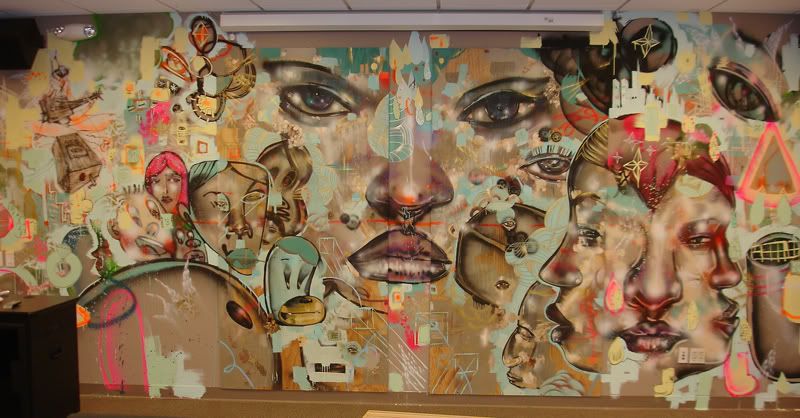
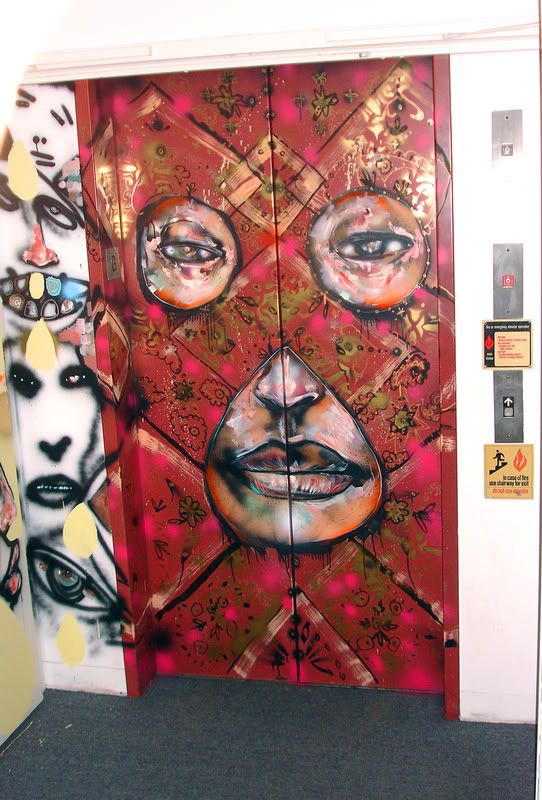
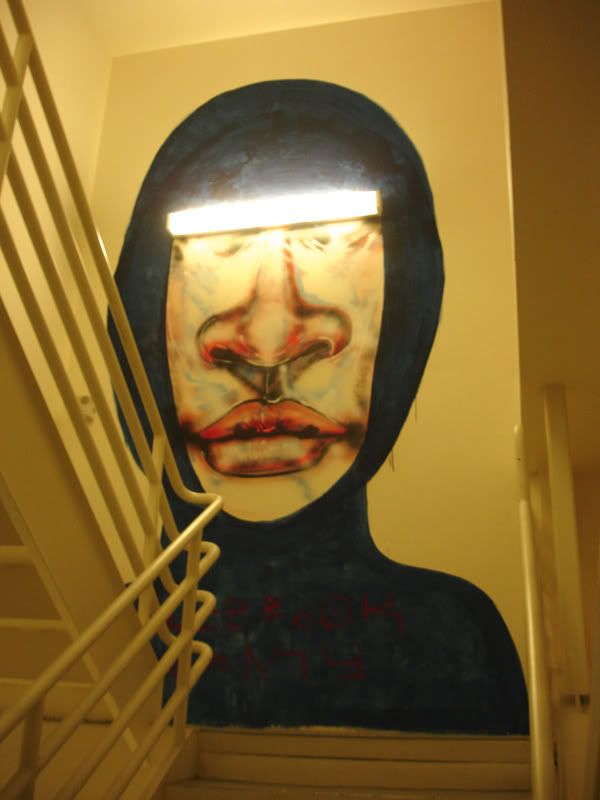
Some really cool murals artists David Choe did for the Facebook building.

Labels: ,

Saturday, April 21, 2007

Blogging Hoffman Style


Mike Tronnes, co-founded the website Cursor.org, was a blogger before most people knew what that was. Like Abbie Hoffman, he used live news broadcasts to criticize the emptiness of TV news, while at the same time advertising for his website.

There is a interesting (short) interview of him at Eyeteeth. Talking about liberal funding he said,

Since most left-of-center foundations don't give grants for general operating support, unlike their counterparts on the right, our proposals have centered on specific projects relating to Media Transparency.

This has reminded of Van Jones speech in which he talked about the need to reorganize how we fund liberal organizing in order to encourage honest critical dialogue about the organizations we are a part of.

Labels: ,

Worth the Thought

Labels: , ,

Wednesday, March 07, 2007

The Final Rotation


Here is a really interesting piece of art I found on Eyeteeth. Artist Matthew Moore created Rotation a replica of a development that was being built on property his parents had just sold. The project was made out of black-bearded wheat for roads and sorghum as houses.

What’s interesting is what the artist has said that this is not protest art.

“If I’m against development, then I’m a hypocrite,” he says. “As farmers we created the model for this type of growth. We came here, ripped apart the native desert landscape, and continually tried to increase our yield per acreage. It’s essentially the business model for any suburban development (from Eyeteeth.)

This raises an interesting conception about the role of the artist (which is something I’ve been thinking a lot about lately.) Moore would seem to be suggesting that all he is not commenting on the development but merely reflecting it. If we posit that the artist is a mirror of zir (gender neutral his/her) society, is it better simply show the world artist sees or should the artist also direct the way the “audience” should feel about a piece? What do you think my glorious readers?

Labels: , ,

Friday, November 17, 2006

Ashes to Art


You all should really checkout Brazilian artist Alexandre Orion. It is a pretty ingenious idea of creating graffiti art by strategically cleaning car exhaust of the wall of an under pass. Learn a little more at Eyeteeth, which is worth a look itself.

Labels: , ,